
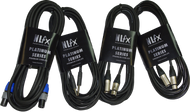
Tech Talk: A Glossary of Common Audio Connectors (XLR, TRS, Speakon)
19th Mar 2026
If you have spent any time in live production, you already know the golden rule: your rig is only as reliable as its absolute weakest point. You can run the most expensive mixing console into top-tier active line arrays, but if the signal is traveling through bargain-bin copper, you are running a vulnerable system.
Understanding signal flow and the specific connectors that carry it is the first step to bulletproofing your rig. Here is a quick breakdown of the three most common professional audio connectors and exactly where you should be using them.
XLR: The Industry Standard
The XLR connector is the undisputed king of professional audio. It is a three-pin, locking connector used primarily for microphones and line-level signals running from your mixer to your active speakers.
-
How it works: XLR cables carry a balanced signal, meaning they use two identical signal wires (one inverted) and a ground wire. This phase-cancellation design actively rejects electromagnetic and radio frequency interference, allowing you to run incredibly long cable lengths across a noisy stage without picking up unwanted hum or buzz.
-
Best for: Microphones, running mains to powered PA speakers, and DMX lighting control.
TRS (1/4-Inch): The Versatile Workhorse
TRS stands for Tip-Ring-Sleeve. While it looks identical to a standard instrument cable (which is TS, or Tip-Sleeve), that extra "ring" on the connector completely changes its capabilities.
-
How it works: A TRS cable can perform one of two distinct jobs. It can carry a single, balanced mono signal (just like an XLR for noise rejection) or it can carry an unbalanced stereo signal (left channel on the tip, right channel on the ring).
-
Best for: Patching outboard gear, connecting studio monitors, headphone outputs, and running line-level signals from interfaces or DJ controllers.
Speakon: The High-Current Power Deliverer
Speakon connectors were developed specifically to solve the dangers and unreliability of running high-current amplifier power through standard 1/4-inch cables.
-
How it works: Speakon connectors feature a twist-and-lock mechanism that prevents accidental unplugging during a show. More importantly, the electrical contacts are completely shielded, meaning you cannot accidentally shock yourself or short out your amplifier if you touch the end of a live cable. They are designed exclusively to carry high-current speaker-level signals.
-
Best for: Connecting dedicated power amplifiers to passive PA speakers and subwoofers.
The NLfx Difference: Why We Build Our Own
It is incredibly easy to treat cables as an afterthought, but mass-produced, off-the-shelf cables are exactly where most budget companies cut corners. They use thin copper, brittle solder points, and cheap shielding that inevitably fails the moment a road case rolls over it.
We got so tired of seeing massive events ruined by cheap, failing connections that we decided to fix the problem ourselves. We build the best cables in the business, hands down. Our custom cables are road-tested, heavy-duty, and built to survive the absolute worst conditions a tour can throw at them. We use premium, high-grade wire and industry-standard connectors so you never have to worry about a dropout when the room is fully packed.
If you are going to invest your hard-earned money in professional audio gear, do not gamble on the wire connecting it. Wire it right the first time. Shop our full line of bulletproof custom cables right here at NLfx Pro!